



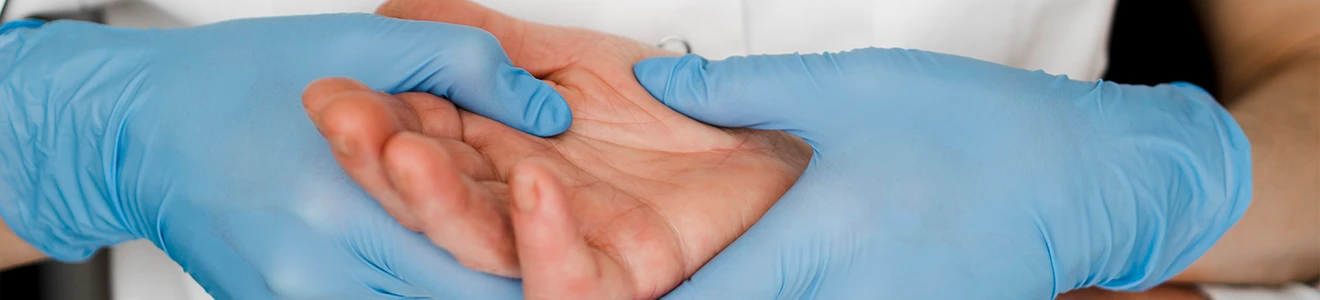
Clinic Overview
Egemed Hand Surgery and Microsurgery Clinic: Function and Quality of Life
The human hand is one of the most complex anatomical structures in the body, where bones, joints, ligaments, tendons, nerves, and blood vessels work in perfect harmony to enable our interaction with the outside world. Even the slightest damage to this delicate mechanism can directly affect a person’s daily activities and occupational functions.
The Egemed Hospitals Hand Surgery and Microsurgery Clinic provides services using current medical approaches in the diagnosis and surgical treatment of conditions affecting the hand, wrist, and upper extremity (arm), ranging from congenital anomalies to workplace injuries, and from rheumatic diseases to nerve compressions. Our primary goal is not only to restore the anatomical integrity of the injured limb but also to help our patients regain maximum functional mobility.

What Conditions Does Hand Surgery Treat?
Trauma and Injuries
- Any cuts or lacerations on the arm, forearm, wrist, and fingers.
- Fractures of the hand, fingers, and wrist, and joint dislocations.
- Repair of tissue defects in the upper extremities resulting from workplace accidents or trauma.
Nervous and Vascular Diseases
- Nerve compression disorders characterized by numbness, tingling, and weakness in the hands (Carpal Tunnel Syndrome, Cubital Tunnel Syndrome, etc.).
- Vascular problems and blockages that impair blood flow to the hands and fingers.
Joint, Tendon, and Congenital Issues
- Trigger finger and tendon sheath disorders.
- Congenital hand deformities (webbed fingers, extra fingers, etc.).
- Pain in the hand and wrist joints, rheumatic diseases of the hands and feet.
- Benign or malignant masses that develop in the hand, arm, and wrist area (such as ganglion cysts).
- Treatment of intra-articular conditions using arthroscopic techniques (Wrist Arthroscopy).
Advanced Technology: Microsurgical Applications
One of the most important factors determining success in hand surgery is microsurgical technique. Blood vessels and nerve structures that are much thinner than a millimeter—and impossible to see or suture with the naked eye—are repaired using specialized surgical microscopes and sutures thinner than a human hair.
In our clinic’s microsurgery department, severed tendon repairs, microvascular (capillary) repairs, nerve grafts (nerve transplantation), and bone grafts are performed with the highest precision. To ensure that the anatomical success achieved after surgery translates into improved daily functioning, we collaborate with our hospital’s Physical Therapy and Rehabilitation unit to design personalized exercise programs for each patient.
Replantation (Reattachment of a Severed Limb) and the "Golden Hours"
Replantation is the surgical procedure in which a body part (particularly a finger, hand, or arm) that has been completely severed or detached as a result of workplace accidents, traffic accidents, or household accidents is reattached using microsurgical techniques and restored to full function. In this highly complex process, after the bones are secured, blood vessels, nerves, and tendons are repaired one by one under a microscope to ensure the severed part is reintegrated into the blood circulation and nerve transmission is restored.
Time Is of the Essence: To prevent the severed tissue from losing its viability, standard medical practice requires that the extremity be preserved under appropriate cold chain conditions and that replantation surgery begin within a maximum of 3 hours. In cases brought to our clinic within these "golden hours," our emergency microsurgery team initiates the surgical process without delay.